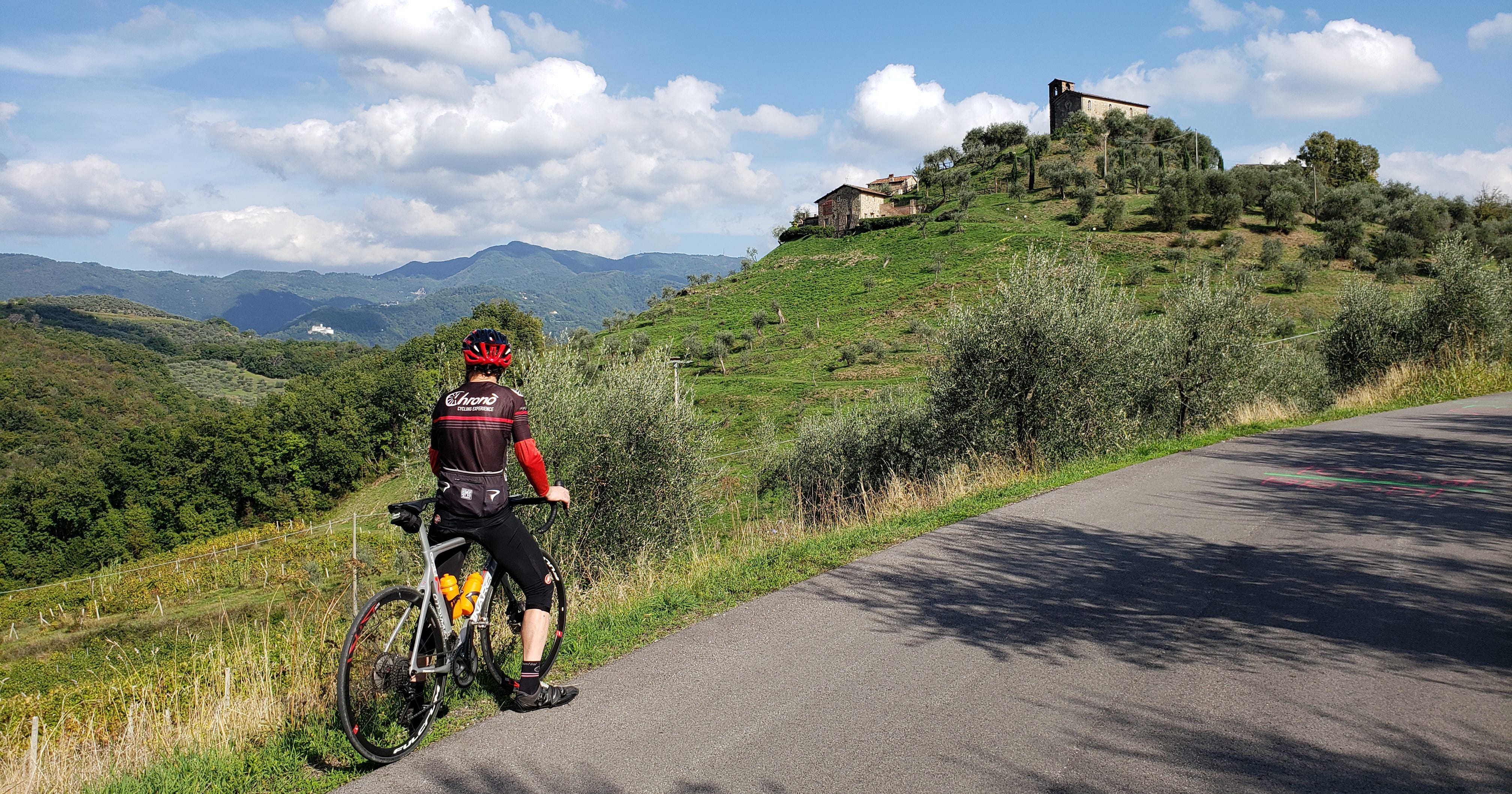
Lucca, Italy: Biking 'Perfection'
Cyclists from around the world make this Tuscan city a popular destination.
A grin splits my face every time I clip into the pedals and push away from my favorite bike shop. I can feel the muscles tighten, and I wonder if my joy is evident to those I pass.
I don’t care. I’m riding in Lucca, Italy.
A narrow street widens to become a ramp that guides me to the top of the famous earthen wall that surrounds this ancient city. I ride past walkers, joggers, and tourists on cruiser bikes. One lap atop The Wall is compulsory; it’s my preamble before leaving the city for the Tuscan hills.
I love riding here. I understand others likely feel the same way about cycling in France or Spain, but to me, Lucca is special. It has everything I need. A reliable, quality bike to rent, stunning roads to ride, and Italian food to cap the day.
Bob Cortright, my regular riding partner at home and a frequent Lucca visitor, introduced me to this cycling paradise many years ago. I’ve ridden here several times since and I’m always ready to do it again. This is a bicycle community. It has been as long as Italians have ridden bikes. Residents living inside The Wall rely on bicycles to navigate the city’s complex web of narrow, cobbled streets and alleys, passages so tight that motorists are disinclined to attempt.
“I think locals have the use of the bike in their blood,” says friend Paladino Meschi, owner of Chronò Bikes. “It is just something that comes spontaneous in most of us. Not all cars are allowed (in the city center), so people feel more safe riding a bike. For those who live within the wall, a bike is a daily essential.”
Dedication to the bicycle extends far beyond the local residents. I’ve ridden here with Americans, Brits, Germans, Aussies, the Dutch, and of course, Italians, and Paladino says his customers span the globe. “After 32 years in the shop, I can say we are known worldwide.”
Here’s why.
Where is Lucca?
Lucca is located in northwestern Tuscany, almost 50 miles west of Florence and 20 miles northeast of Pisa. There are nearby Italian hamlets to explore and hills to climb. It’s also easy to ride to the Ligurian Sea.
Lucca is accessible by train or bus from Florence, and by bus from Pisa. The area, first settled by the Ligurians and later the Etruscans in the plains along the Serchio River, was eventually commandeered by the Romans in 180 B.C. It was the Romans who built the first wall and an amphitheater here.
The Romans built two walls before departing five centuries later. Then, in 1580, the city-state of Lucca constructed a new, higher, wider defensive barrier to help ward off warring attackers from Florence and Pisa.
That wall, standing 39 feet high and 98 feet wide on top, remains. It provides a 2.6-mile paved promenade for everyone to enjoy. One lap on a bike or on foot should be a prerequisite for anyone visiting the city today.
The Cycling Experience
I start my May 2025 ride at Chronò Bikes, where I’ve rented a Pinarello X5 road bike, and pedal two short blocks to The Wall. I have options from here. Do I head northwest into the Tuscan-Emilian Apennines mountain range and twist my way up to Fiano di Pescaglia (elevation 1,391 feet)? Or should I make my way northeast to Matraia (elevation 977 feet)? Both are rewarding rides.
To the south is Monte Serra, positioned between Lucca and Pisa. At 3,008 feet, this is perhaps the most renowned climb in the region. Road grades average between 4 and 9 percent, depending on the approach. We’ve taken the easier ascent in the past, riding east to west through the town of Buti and celebrating 2,700 feet of climbing at the summit 8 miles later.
But perhaps the best experience is the one not planned. I’ve enjoyed afternoons where I leave the decisions to Paladino and simply follow his wheel along stunning single-lane country roads I’d never find on my own. We frequently stop along the way to enjoy views down to the Lucca Plain. And, at my request, each ride includes a stop at a remote coffee bar where a double espresso macchiato can be peacefully savored.

Ride with a Guide
Chronò Bikes offers daily guided and self-guided tours based on skill levels. There are also wine tasting, olive oil tasting rides, and package tours are also available. Road bikes, e-bikes, and cruisers for in-town exploration are there as well.
“We only guide people in the countryside. We’re not historical guides,” Paladino says, “so we let people decide where they want to go or what they want to do and we plan the best route for them.”
Some, he adds, want to climb while others simply want to ride west to the Ligurian Sea for a waterfront lunch, a dip in the water, and a return ride to Lucca.
“Our territory offers lots of alternatives,” he says. “Contrary to Siena where it is stunning but only hilly, in our area you can go for a flat ride, up on the mountains, to the seaside. Anything is possible.”
Bob Cortright and I agree.
“It’s everything you could want in one place,” Bob says. “You see fabulous roads on TV while watching the Giro d’Italia and then here they are. Quiet, narrow roads and spectacular climbs. It’s perfection.”
Dan Shryock is a travel writer and career journalist who focuses on cycle tourism. Based in Oregon, his work has appeared in magazines and websites in California and the Pacific Northwest. His book, “Cycling Across Oregon: Stories, Surprises & Revelations Along the State’s Scenic Bikeways,” is available on Amazon.